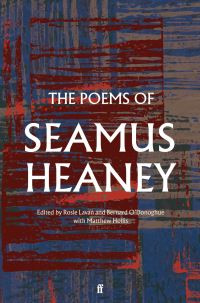
Reading The Poems of Seamus Heaney cover-to-cover, the real revelation is how he endures. So many poets burn out: Heaney didn't.
The Telegraph
The resulting volume lets us see Heaney's work, whose ripples we are still learning to navigate, for the colossal achievement it is, and it reminds us that Heaney is not only a keeper but an enricher of the word-hoard.
Guardian - Phillip Terry
As so often in Heaney's poems, the reader of "Ribbons" is transported by the steady, illuminating work of his memory Some readers will have followed Heaney from the very beginning; many, we hope, will discover or rediscover him through this volume. [...]
Irish Times
The glorious gathering-in of his achievement that is The Poems of Seamus Heaney, edited with meticulous care and luminous clarity. . . allows us for the first time to see his dozen formal collections as only the most visible peaks in a constantly rolling range of creativity.
Observer - Fintan O'Toole
'Heaney's voice, by turns mythological and journalistic, rural and sophisticated, reminiscent and impatient, stern and yielding, curt and expansive, is one of a suppleness almost equal to consciousness itself.'
Helen Vendler
The Poems of Seamus Heaney, edited with ?meticulous care and luminous clarity [...] [Seamus Heaney] and his poetry were fit for the strain, and in these darkening times, his words help us to be so too.
Observer - Fintan O'Toole
Heaney's poetry is known and recited in an age when poetry is a marginal art form; he was that now-extinct thing, the poet-celebrity whose poems are very, very good.
The Times - Laura Hackett
'His is "closeup" poetry - close up to thought, to the world, to the emotions. Few writers at work today, in verse or fiction, can give the sense of rich, fecund, lived life that Heaney does.'
John Banville
'For Heaney, there were marvels enough in this world, and never mind the next. Ordinary objects and places - a sofa, a wireless, a satchel, a gust of wind, the sound of rain - were sanctified.'
Blake Morrison
'These poems find - in the dowser's gift and the child's perception of the world - images of the marvellous that are also wonderfully grounded. . . Heaney is a poet who deserves to be read in entirety.'
Jamie McKendrick
'More than any other poet since Wordsworth he can make us understand that the outside world is not outside, but what we are made of.'
John Carey
For Irish readers,Heaney remains a touchstone. The rural boy made good, the Nobel laureate who never lost the cadence of Mossbawn, the poet who could move between bog and boardroom, Glanmore and Harvard, with ease. The editors approach their task with reverence and rigour
Irish Independent - Paul Perry
Despite his international profile, Heaney was, to friends and family in Bellaghy, just "our Seamus" [...] Heaney's focus is on the seemingly insignificant thing: a tiny bird. The swallow is, in this majestic landscape, a "little soul" worthy of attention, worthy of poetry.
Sunday Times
Seamus Heaney was born in County Derry in Northern Ireland. Death of a Naturalist, his first collection of poems, appeared in 1966, and was followed by poetry, criticism and translations which established him as the leading poet of his generation. In 1995 he was awarded the Nobel Prize in Literature, and twice won the Whitbread Book of the Year, for The Spirit Level (1996) and Beowulf (1999). Stepping Stones, a book of interviews conducted by Dennis O'Driscoll, appeared in 2008; Human Chain, his last volume of poems, was awarded the 2010 Forward Prize for Best Collection. He died in 2013. His translation of Virgil's Aeneid Book VI was published posthumously in 2016 to critical acclaim, followed in 2018 by 100 Poems, a selection of poems from his entire career, chosen by his family.
A Times Literary Supplement , Telegraph and Financial Times Best Book of 2025
'The glorious gathering-in of his achievement that is The Poems of Seamus Heaney, edited with meticulous care and luminous clarity. . . allows us for the first time to see his dozen formal collections as only the most visible peaks in a constantly rolling range of creativity.' Fintan O'Toole, Observer
'This book is a landmark. [and] lets us see Heaney's work, whose ripples we are still learning to navigate, for the colossal achievement it is, and it reminds us that Heaney is not only a keeper but an enricher of the word-hoard.' Philip Terry, Guardian
This is the long-awaited, definitive edition of Seamus Heaney's poetry. It encompasses all the poems Heaney published in his lifetime as well as the small number that appeared after his death: twelve single volumes, from Death of a Naturalist (1966) to Human Chain (2010), and those poems published in pamphlets, journals and magazines or with limited circulation. In addition, the book includes a selection of unpublished material chosen by the poet's family.
It is a body of work that, in its entirety, resounds with the 'lyrical beauty and ethical depth' cited by the Nobel committee: poems 'which exalt everyday miracles and the living past.'
Critical introductions to each collection and notes that illuminate the history and development of the poems make this the essential volume for admirers of Heaney's work.
'Heaney's voice, by turns mythological and journalistic, rural and sophisticated, reminiscent and impatient, stern and yielding, curt and expansive, is one of a suppleness almost equal to consciousness itself.' Helen Vendler
'More than any other poet since Wordsworth he can make us understand that the outside world is not outside, but what we are made of.' John Carey
'His is "closeup" poetry - close up to thought, to the world, to the emotions. Few writers at work today, in verse or fiction, can give the sense of rich, fecund, lived life that Heaney does.' John Banville
'These poems find - in the dowser's gift and the child's perception of the world - images of the marvellous that are also wonderfully grounded. . . Heaney is a poet who deserves to be read in entirety.' Jamie McKendrick
'For Heaney, there were marvels enough in this world, and never mind the next. Ordinary objects and places - a sofa, a wireless, a satchel, a gust of wind, the sound of rain - were sanctified.' Blake Morrison